
Note: If this is your first baby, or if all your prior births were vaginal births, then the primary C-section rate is the rate you care about and this article is relevant for you. But if you’ve had a cesarean birth in the past, then you should look at hospital VBAC rates instead.
This is the woman-centric language version (e.g., “mother”, “pregnant woman”, “birthing woman”, “breastfeeding”). Also available: gender-neutral language version (e.g., “parent”, “pregnant person”, “birthing person”, “breast/chestfeeding”).
Where you choose to give birth can substantially increase or decrease your chances of having a C-section.
Like most women, you may hope to avoid an unplanned cesarean if possible. But you may assume that whether you end up with a C-section or with a vaginal birth is determined by what happens during labor — depending on the baby’s size or position, how labor progresses, or a medical problem.
All of those things matter. But there is another powerful factor that is decided before your labor begins: the hospital and care team you choose. In fact, hospital culture — which includes norms, policies, staffing, and protocols for managing labor — can play a major role in determining whether you will end up having a C-section instead of the vaginal birth you hope for. (Here’s a link to one really good study, Cesarean overuse and the culture of care, that demonstrates the power of hospital culture in driving C-section rates.)
These differences in culture go a long way to explaining why Chicago-area hospitals vary widely in their rates for first-time C-sections for low risk women, and why these differences remain even after the rates are adjusted to take account of common risk factors.
Chicago-area hospital C-section rates
According to the most recent Illinois Hospital Report Card, primary C-section rates at Chicago-area hospitals ranged from 7.5% (at Loyola MacNeal Hospital) to 23.3% (at Humboldt Park Health). These are risk-adjusted rates. So even accounting for differences in the patient populations, there is a three-fold difference between the highest and lowest primary C-section rates at hospitals in our area.
The primary C-section rates referenced in this article are reported in the Illinois Hospital Report Card, and represent the number of Cesarean deliveries per 1000 births among women with no history of previous Cesarean delivery. Rates are reported in this article as percentages (number per 100 births). The rates exclude births where a hysterectomy was performed and also exclude births with specific complications (abnormal presentation, preterm delivery, fetal death, multiple gestation diagnoses, or breech procedure), as specified by the Agency for Health Care Research and Quality.
BirthGuide looked at the rates for the 38 hospitals in Cook, DuPage, Kane, Lake, McHenry and Will counties that offered labor and delivery services as of 9/1/2026.
Comparing the single highest- and lowest-rate hospitals can be misleading, however.
So as another way to show how much hospital choice can matter, BirthGuide compared two groups of Chicago-area hospitals: those with the lowest and those with the highest primary C-section rates.
Low primary C-section rate hospitals: Of the 38 hospitals we looked at, six Chicago-area hospitals have primary C-section rates that we categorized as “among the lowest.” (These are the six hospitals with primary C-section rates at least one standard deviation lower than the mean for hospitals that currently support labor and delivery in Cook, DuPage, Kane, Lake, McHenry and Will counties during the reporting period October 2024 through September 2025.)
At these six hospitals, 6,005 low-risk women who had not had a prior C-section gave birth, and 642 of them gave birth by cesarean. That is an overall primary C-section rate of 10.7%.
High primary C-section rate hospitals: Now let’s compare that with the six Chicago-area hospitals with primary C-section rates that we categorized as “among the highest.” (These are the six hospitals with primary C-section rates at least one standard deviation higher than the mean for the same group of hospitals.)
At these six hospitals, 7,075 low-risk women who had not had a prior C-section gave birth, and 1,315 of them gave birth by cesarean. That is an overall rate of 18.6%.
That is a difference of about eight C-sections for every 100 women:
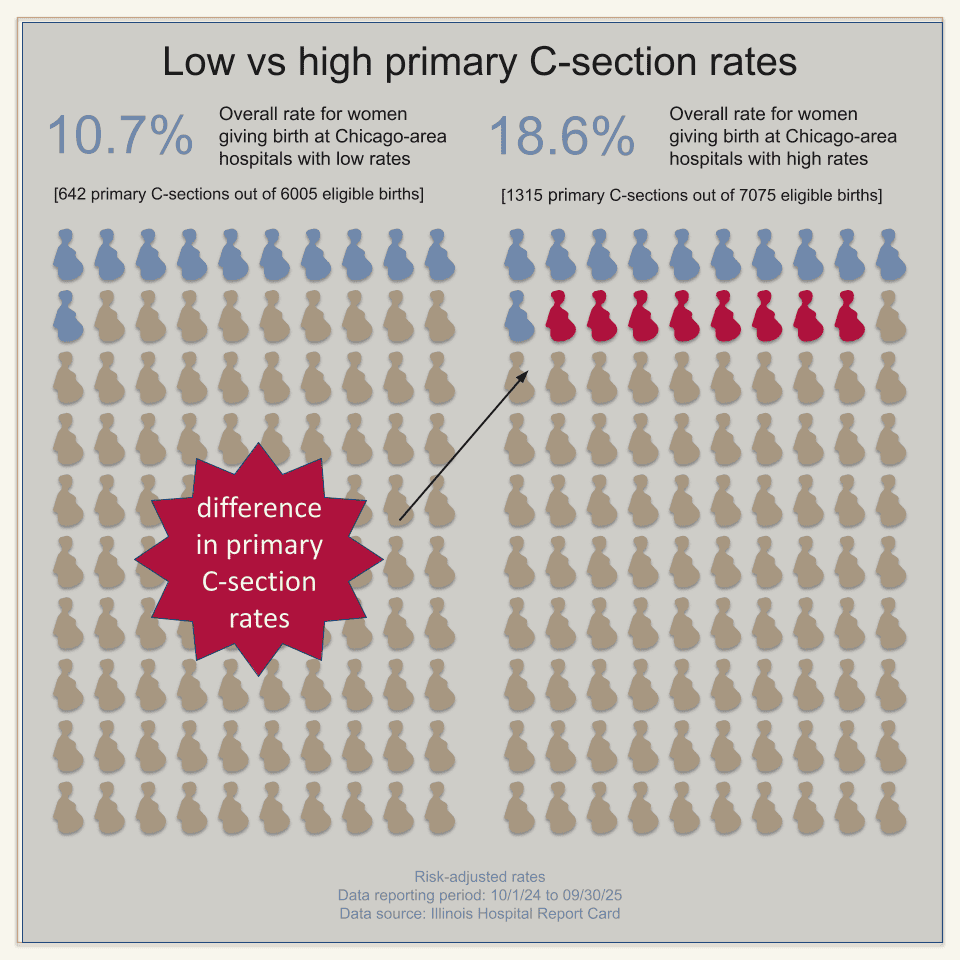
This means that low-risk women who chose the hospitals with the highest rates were almost twice as likely to have a first-time C-section as women who chose hospitals where the primary C-section rate was “among the lowest.”
This does not mean that any individual woman would have avoided a C-section if she had given birth at one hospital vs another. But the size of the difference matters because it shows that medical need alone does not determine whether you will have a C-section: your choice of hospital also plays an important role in determining your C-section risk.
Why does the hospital make so much difference?
The management of labor does not follow a fixed set of rules. Doctors, midwives, and nurses must make many judgment calls, such as:
-
- When an induction should be recommended?
- How much time should an induction be given to work?
- Are doulas welcomed and supported?
- When does slow labor become “failure to progress”?
- What changes in the baby’s heart rate require action?
- Can the woman move and change positions?
- Is intermittent monitoring available?
- What can be tried before a C-section is recommended?
- How should the care team respond when the situation is uncertain but not an emergency?
The answers can vary from one hospital to another. They can be influenced by staffing, hospital rules, work schedules, concerns about lawsuits, recent bad outcomes, and what the people in that hospital see as normal. That is what we mean by hospital culture.
And while hospital culture may be difficult to measure, it is reflected in patterns of care. A hospital’s primary C-section rate is one of those patterns.
Which Chicago-area hospitals have the lowest primary C-section rates?
The following hospitals in BirthGuide Chicago’s coverage area currently have the lowest reported risk-adjusted primary C-section rates (at least 1 standard deviation less than the average for all Chicago-area hospitals).
| Hospital | City | Risk-adjusted primary C-section rate | # of primary C-sections | # of eligible births |
| Loyola MacNeal Hospital | Berwyn | 7.5% | 45 | 601 |
| Roseland Community Hospital | Chicago | 9.3% | 8 | 86 |
| Endeavor Highland Park Hospital | Highland Park | 10.7% | 128 | 1191 |
| Advocate Condell Medical Center | Libertyville | 11.1% | 113 | 1017 |
| Endeavor Evanston Hospital | Evanston | 11.2% | 268 | 2399 |
| Loyola University Medical Center | Maywood | 11.3% | 80 | 711 |
Source: Illinois Department of Public Health, Illinois Hospital Report Card, reporting period Oct 2024 – Sept 2025. Data accessed Sept 1, 2026.
These additional hospitals have primary C-section rates that are lower than the average:
| Hospital | City | Risk-adjusted primary C-section rate | # of primary C-sections | # of eligible births |
| Saint Anthony Hospital | Chicago | 11.8% | 80 | 680 |
| Endeavor Northwest Community Hospital | Arlington Heights | 11.8% | 174 | 1475 |
| Advocate Sherman Hospital | Elgin | 12.3% | 164 | 1337 |
| Advocate Lutheran General Hospital | Park Ridge | 12.5% | 327 | 2623 |
| Endeavor Elmhurst Hospital | Elmhurst | 12.6% | 299 | 2375 |
| Advocate Trinity Hospital | Chicago | 12.6% | 49 | 389 |
| Olympia Fields Hospital | Olympia Fields | 12.7% | 84 | 662 |
| Endeavor Swedish Hospital | Chicago | 13.0% | 181 | 1394 |
| Northwestern Medicine Lake Forest Hospital | Lake Forest | 13.1% | 155 | 1180 |
| UChicago Medicine AdventHealth Bolingbrook | Bolingbrook | 13.3% | 87 | 655 |
| Northwestern Medicine Central DuPage Hospital | Winfield | 13.3% | 256 | 1919 |
| Advocate Good Shepherd Hospital | Barrington | 13.4% | 75 | 558 |
| Northwestern Memorial Hospital/Prentice | Chicago | 13.8% | 1173 | 8515 |
| Advocate Christ Medical Center | Oak Lawn | 14.0% | 361 | 2576 |
| Advocate Good Samaritan Hospital | Downers Grove | 14.3% | 150 | 1049 |
Source: Illinois Department of Public Health, Illinois Hospital Report Card, reporting period Oct 2024 – Sept 2025. Data accessed Sept 1, 2026.
Choosing a lower-rate hospital improves the odds that you will avoid a C-section
The likelihood that you will end up having a C-section will depend on your health, your pregnancy, your baby, what happens during labor, and the decisions you and your care team make. Even at a hospital with a very low primary C-section rate, you may end up with a C-section. But if you’ve chosen your birth setting thoughtfully, you are much less likely to wonder whether that C-section was truly necessary.
Questions to ask a doctor or midwife
Your choice of care team is also important. If avoiding an unnecessary C-section is important to you, ask:
- What is your practice’s primary C-section rate?
- How does it compare with the hospital’s rate?
- When do you usually recommend induction?
- How much time do you give an induction to work?
- How do you decide that labor has stopped progressing?
- If the mother and baby are doing well, how much time do you allow labor to continue?
- Is intermittent monitoring available to women who qualify for it?
- Can women move freely and use different positions during labor and pushing?
- Who will care for me if you are not on call?
- When more than one option is medically reasonable, how do you help patients make the decision?
Pay attention to how the provider answers. A willingness to explain the options and take your priorities seriously may be as important as the answers themselves.
Primary C-section rates are lowest of all for those who choose community birth
Here in the Chicago area, women who plan to give birth at home or in a freestanding birth center (“community birth”) generally have a 3% to 4% chance of ending up with a cesarean. That’s materially lower than the lowest hospital rates (which range from about 7% to 11%), and substantially lower than the highest hospital rates (which range from about 17% to 23%).
Of course, women who qualify to give birth in these out-of-hospital settings are very low-risk to begin with, so they are less likely to need a C-section wherever they give birth. And since these out-of-hospital rates are self-reported and not risk-adjusted, they cannot be compared directly to the primary cesarean rates at hospitals.
Still, if you qualify to give birth at home or at a freestanding birth center, these rates do give you a fair picture of how very low your cesarean risk could be. If avoiding a C-section is a top priority for you, these could be good options to consider.
BirthGuide offers lots of information to help you decide. You can take the “where should I have my baby?” questionnaire to see if home birth or a birth center might be right for you. You can also hear birth stories, learn more about the pros and cons of each setting, compare home birth and birth centers to hospital birth, and find home birth midwives and birth centers.